Briefings
In a Moody's first, a stablecoin earns an A2/P-1 rating
Stablecoins have spent most of their short life graded by the market, by their issuers' own attestations, and occasionally by the wreckage of a failure. On October 27, Moody's Ratings gave one a conventional credit rating: A2 long-term and P-1 short-term on Ripple USD (RLUSD), a $2.6 billion digital dollar issued by a New York-regulated Ripple subsidiary. Ripple calls it the first stablecoin to earn an investment-grade rating from Moody's.
The timing is not accidental. A federal stablecoin law takes effect no later than January 2027, institutions are weighing whether these tokens can sit alongside their cash, and the rating agencies are deciding how to speak about them. This rating is an early test of Moody's new rulebook for the sector, and it turns out to say as much about the issuer and the plumbing as about the Treasury bills underneath. Here is what it covers, what it means, and what remains open.
Why now: from trainwrecks to scaffolding. The sector's record explains why an independent credit opinion matters. In May 2022, TerraUSD, an algorithmic stablecoin with no real reserve, collapsed and took tens of billions of dollars of value with it. In March 2023, USDC, among the more conservatively run coins, briefly fell to about 87 cents after Circle disclosed that $3.3 billion of its reserve sat at the failed Silicon Valley Bank. Tether, still the largest, settled with the New York Attorney General in 2021 over past statements about its backing, and New York regulators halted new issuance of Paxos's BUSD in 2023.
Lawmakers have since started building scaffolding. The GENIUS Act, signed in July 2025, created the first federal framework for payment stablecoins: full backing in cash and short-term Treasuries, regular public disclosure of reserves, and priority for holders if an issuer fails. It takes effect no later than January 18, 2027, and the OCC finalized its implementing rule for federally supervised issuers on October 21, six days before the rating. A broader market-structure bill, the CLARITY Act (the subject of CCM's September piece), passed the House in July 2025 but stalled in the Senate in September, partly over whether stablecoins should be allowed to pay holders yield, which banks fear would pull deposits away.
Law sets a floor. It does not tell an investor how one compliant issuer compares with another. That is the gap a rating aims to fill.
What's new about this rating. Three things set it apart.
An investment-grade first. Ripple calls RLUSD the first stablecoin to receive an investment-grade rating from Moody's, and no earlier investment-grade rating of a fiat-backed stablecoin by a major agency could be found.
A new rulebook, applied. RLUSD was rated under Moody's Stablecoin methodology, published in March 2026, making it an early application of the new framework. Earlier this month Moody's assigned a B3 to Sky Protocol, the issuer behind the crypto-backed USDS and DAI, but that rates the issuer, not a token.
A different assessment from S&P's published scores. S&P's published stablecoin scores are stability assessments, which S&P itself distinguishes from credit ratings. It scores tokens from 1 to 5 on their ability to hold the peg, which depends on market trading as well as redemption (USDC scores a 2, "strong"; USDT a 5, "weak", per its August 2026 summary) and rates some issuers separately, such as Sky at B-. S&P also has a separate framework for credit ratings on stablecoins. Moody's rating is instead a credit opinion on the redemption promise itself: whether holders who redeem get paid in full and on time. The two can diverge. In March 2023, USDC briefly traded near 87 cents even though Circle went on to honor redemptions at par.
What does a rating add that a monthly reserve attestation doesn't? An attestation tells you what was in the reserve on one day. A rating is a forward-looking judgment, from a firm whose core business is adjudicating credit and liquidity risk, on whether holders will be repaid, weighed against everything that could get in the way: the issuer, the custodian, the legal structure, the technology. It is monitored and can change. And it puts a stablecoin on the same scale treasurers already use for bank deposits and money funds, the scale their investment policies, collateral schedules and risk committees are built around.
Like a money fund, but not one. For readers who come to this from cash management rather than crypto, the closest familiar analogue is a government money market fund. Both promise a dollar back for every dollar in, and both hold short-dated Treasuries and cash to keep that promise. The comparison is useful but not an equivalence: a stablecoin is neither a fund share nor an insured bank deposit. RLUSD is a claim on its issuer for redemption, governed by the issuer's terms and the law.
The mechanics of a fiat-backed stablecoin are simple. An institution sends dollars, the issuer mints the same number of tokens and invests the cash in a reserve, and when the holder redeems, the issuer burns the tokens and pays out from the reserve. The tokens themselves live on a blockchain, which lets them move between parties in minutes, at any hour.
Exhibit 1
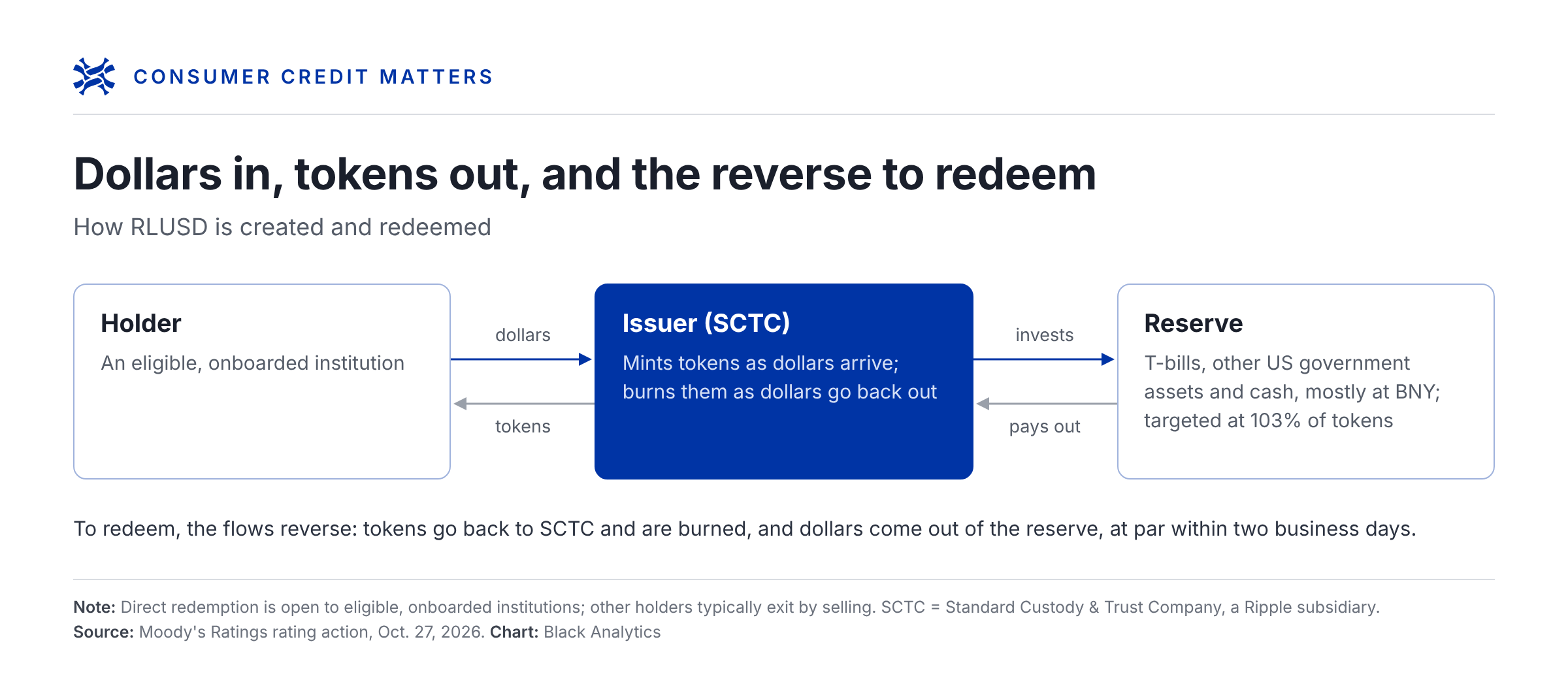
The differences matter as much as the similarities:
| Government money fund | RLUSD | |
|---|---|---|
| Value target | $1 per share | $1 per token |
| Assets | T-bills, repo, government securities | T-bills, government assets, cash (mostly at BNY) |
| Yield to holder | Interest passes through | None; issuer keeps the income |
| Who can redeem | Any shareholder, through the fund | Onboarded institutions, at par within 2 business days |
| How it moves | Via transfer agent, business hours | On a blockchain, around the clock |
| Main rulebook | SEC Rule 2a-7 | NYDFS today; GENIUS Act from 2027 |
| If the sponsor fails | Fund assets held apart from the adviser | Reserve segregated; issuer not bankruptcy-remote |
That last row is where much of the rating story lies.
Meet RLUSD. RLUSD is issued by Standard Custody & Trust Company (SCTC), a Ripple subsidiary chartered as a trust company and supervised by the New York Department of Financial Services. It launched in December 2024 and is aimed mainly at institutions; Ripple says it is used chiefly in its payments business and as collateral in its prime brokerage. Ripple's newly chartered national trust bank, which the OCC supervises, may later take on reserve and trustee roles.
As of October 27, at about $2.6 billion, RLUSD was the ninth-largest stablecoin. That was under 1% of a roughly $300 billion market dominated by two names: Tether's USDT (about 61%) and Circle's USDC (about 24%). It has grown quickly, though, from about $1.7 billion in early June.
Its reserve is held mostly at BNY, the large custody bank, in Treasury bills, other short-term US government assets and cash. According to Moody's, SCTC targets reserves equal to 103% of tokens outstanding, a 3% cushion above full backing.
What the two grades say. The P-1 speaks to near-term capacity to meet redemptions, which a reserve of T-bills and cash readily supports. The A2 is Moody's view of the risk of holding RLUSD over a longer horizon: the chance that a holder who asks for a dollar doesn't get it in full and on time, and the loss if so. That is where slower-moving, lower-probability risks show up. Moody's says the P-1 is aligned with the A2, so the long-term grade is the anchor. Neither is a guarantee of on-time redemption or a $1 market price.
Moody's calls these deposit ratings, borrowing its bank deposit scale. That makes comparisons possible, with a caveat: a bank earns its grade through its whole balance sheet and expected government support, a different path to the same letters.
Why not higher? If the reserve is mostly Treasuries, why isn't the rating near the top? Because the assets do not appear to have been the binding constraint. Treasuries carry the US government's own rating, Aa1, so that is roughly where an analysis of the reserve alone would start. The gap down to A2 reflects other factors, and Moody's has not yet said how much each one contributed.
Three features stand out in Moody's announcement and its published methodology.
1. The issuer matters as much as the assets. SCTC creates, destroys and redeems the tokens. Under Moody's methodology, a rating of A2/P-1 or higher generally requires either that key operating parties carry ratings at that level or that strong backup arrangements exist. SCTC has no public Moody's rating and has operated since December 2024. The announcement does not say which route applied.
2. Timing counts, not just eventual repayment. A deposit rating covers getting paid on time. Moody's notes that if SCTC went bankrupt, a court-ordered stay could delay redemptions beyond the usual two business days, even if holders were eventually repaid in full.
3. The legal separation is real but not complete. The reserve is segregated and dedicated to holders, but, as Moody's states, SCTC is not a bankruptcy-remote special purpose entity, and holders do not currently have a direct ownership interest in the reserve. Moody's cites New York oversight and account arrangements as mitigants, and notes that the federal GENIUS Act, taking effect no later than January 18, 2027, will add protections, including keeping required reserves out of an issuer's bankruptcy estate. Until then, those protections do not apply.
The 3% cushion guards against the reserve losing value. It does little for the risks above, which concern the issuer and the plumbing rather than the assets.
What exactly is rated. The rating is narrower than the name might suggest. In Moody's words, it "applies solely to RLUSD natively issued by SCTC on the XRP Ledger and Ethereum," meaning tokens SCTC creates directly on those two blockchains. Moody's does not list what falls outside; the categories in Exhibit 2 are CCM's reading of that line.
Exhibit 2
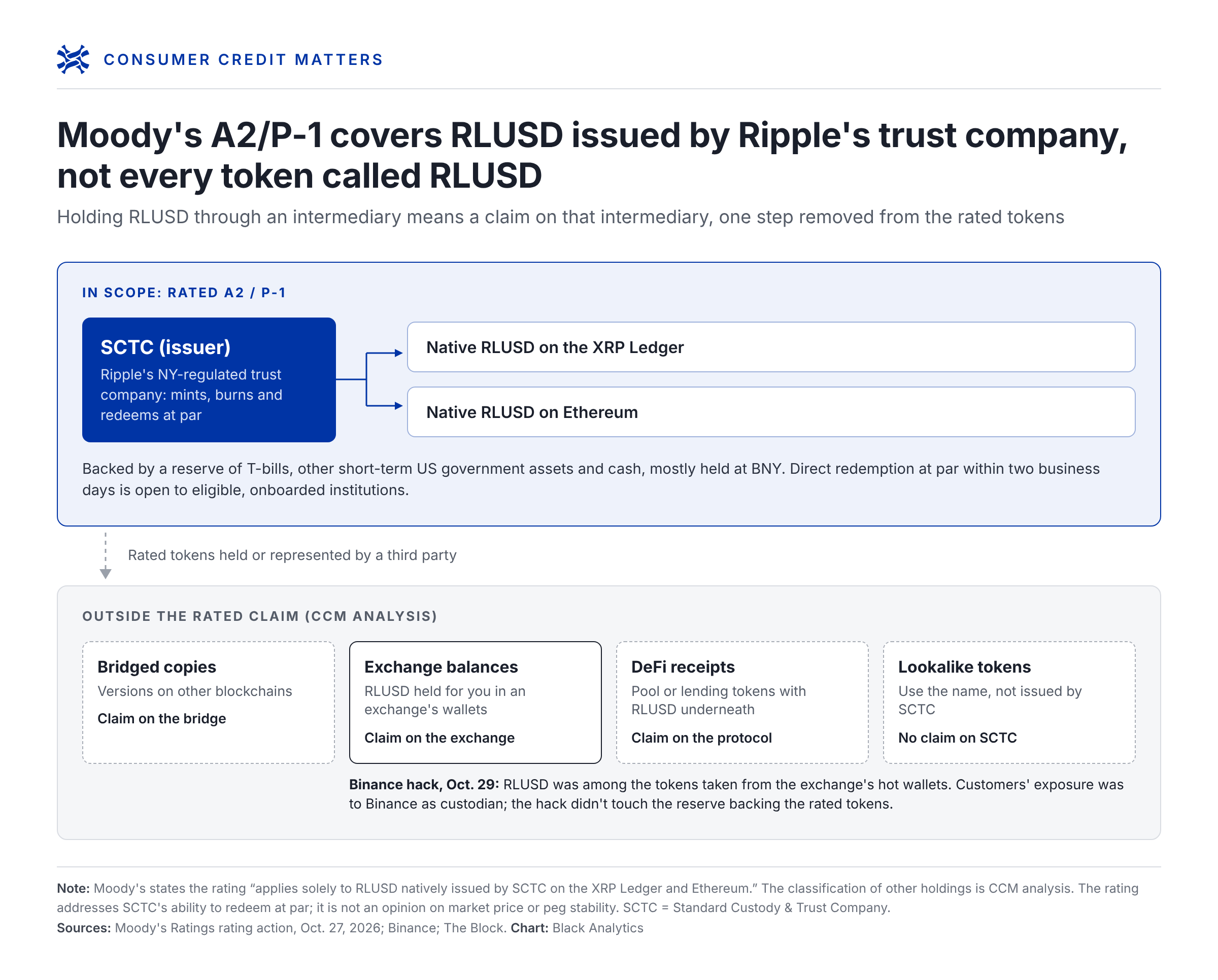
RLUSD can also be held in ways that put a third party between the holder and SCTC: copies on other blockchains created through a bridge, balances at a crypto exchange, or receipts from decentralized finance protocols. Holders in those positions own a claim on the bridge, exchange or protocol, which in turn holds the rated tokens. Anyone can also create a token called RLUSD; only SCTC's count.
By location, nearly all RLUSD sits on the two rated chains; in mid-September about 57% was on Ethereum and 43% on the XRP Ledger. But redeeming directly with SCTC is open only to eligible institutions that have completed onboarding. Everyone else gets out by selling, typically through an exchange. How much RLUSD is held directly by redemption-eligible institutions is not public.
A live illustration: the Binance hack. Two days after the rating, on October 29, attackers drained Binance's hot wallets across roughly ten blockchains, a loss Binance puts at about $6.3 billion and says it has since covered about 95% of the losses from its own reserves and corporate funds. Withdrawals reopened on November 1, and the FBI has attributed the theft to TraderTraitor, a North Korean state-backed group. RLUSD was among the tokens taken, and Ripple froze part of it, as Tether, Circle and others did with their stablecoins. Reported figures for the RLUSD freeze still conflict.
The episode shows why scope matters. Binance customers holding RLUSD had their exposure to Binance as custodian, not a direct claim on SCTC, and the hack did not touch the reserve backing the rated tokens. Binance.US, a separate company, was reported unaffected. It also shows a feature the rating has to account for: the issuer can freeze tokens, which is a useful control, but a holder whose tokens are frozen cannot redeem them.
What isn't known yet. Moody's says a new issue report with fuller analysis is coming soon. Two questions stand out.
Frozen tokens. Federal rules point one way: the OCC's final rule, which governs the issuers it supervises, does not require redemption where it would violate sanctions or anti-money-laundering law, so a legally required freeze is not, on its face, a redemption failure. How Moody's treats freezes, including those made for security reasons as after the Binance hack, is not yet spelled out.
Ripple's new trust bank. The OCC gave Ripple National Trust Bank final approval on October 26, the day before the rating. It may manage RLUSD's reserve and act as collateral trustee for holders. Moody's release does not mention it. The OCC's final rule expressly permits reserve trust arrangements that give holders a security interest in the reserve. A trustee holding a priority interest for holders resembles an upgrade factor Moody's names; replacing BNY as custodian with a new, unrated affiliate resembles a downgrade factor. Which role it takes, and when, could drive the next rating change.
Others remain open too, including the legal analysis behind the reserve's segregation today, which safeguards or backup arrangements support a rating at this level, whether the 103% coverage is a binding commitment, and how the analysis treats redemption limited to onboarded institutions.
Why it matters. For corporate treasurers and institutions, a rating from a major agency makes a stablecoin legible in familiar terms. Many investment policies set minimum ratings for where cash can sit, and A2/P-1 is a common threshold. RLUSD clears it, though without much room to spare.
For the market, this is an early application of a new methodology, and early cases tend to set the template. Whether larger issuers such as Circle or Paxos seek Moody's ratings, and where they land, will show how well the framework separates stronger structures from weaker ones.
One limit is worth keeping in mind: the rating addresses SCTC's ability to redeem at par. It is not a view on the token's market price, and it is not deposit insurance.
CCM read: The A2 appears to say less about the Treasuries than about the plumbing: an unrated issuer at the center of minting and redemption, no bankruptcy-remote vehicle, and direct redemption limited to onboarded institutions. For structured finance readers, the toolkit is familiar: collateral, structure, counterparties, timeliness. The closer analogue, though, is a covered bond rather than ABS: an issuer-dependent claim backed by a segregated pool under a legal and regulatory framework, with no bankruptcy-remote vehicle in between. What Moody's has not yet shown is how it weighed those factors, or how Ripple's new trust bank will figure. CCM will revisit when the new issue report is published.
Q3 GDP beats at 3.4%, but households are drawing down savings to do it
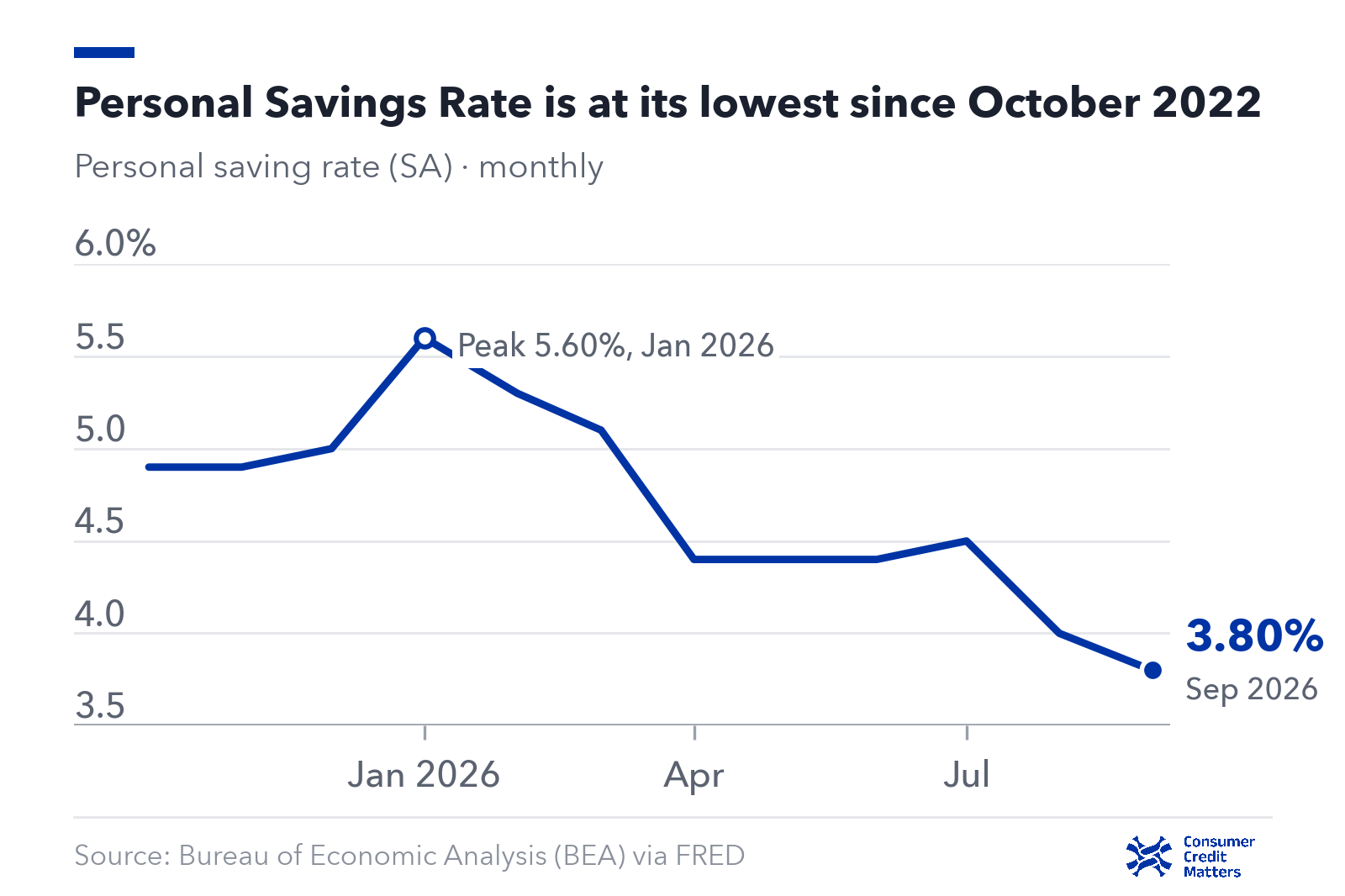
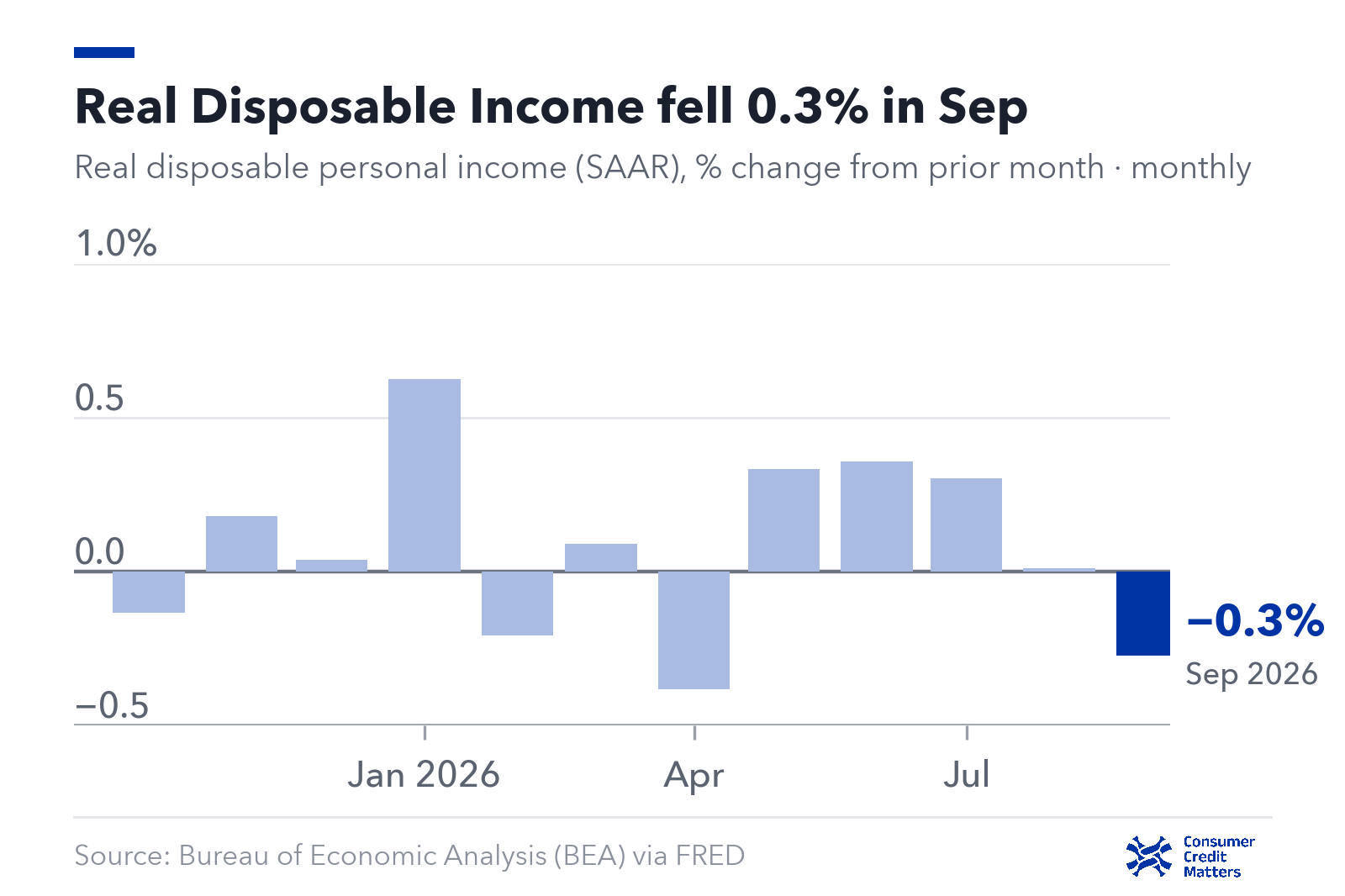
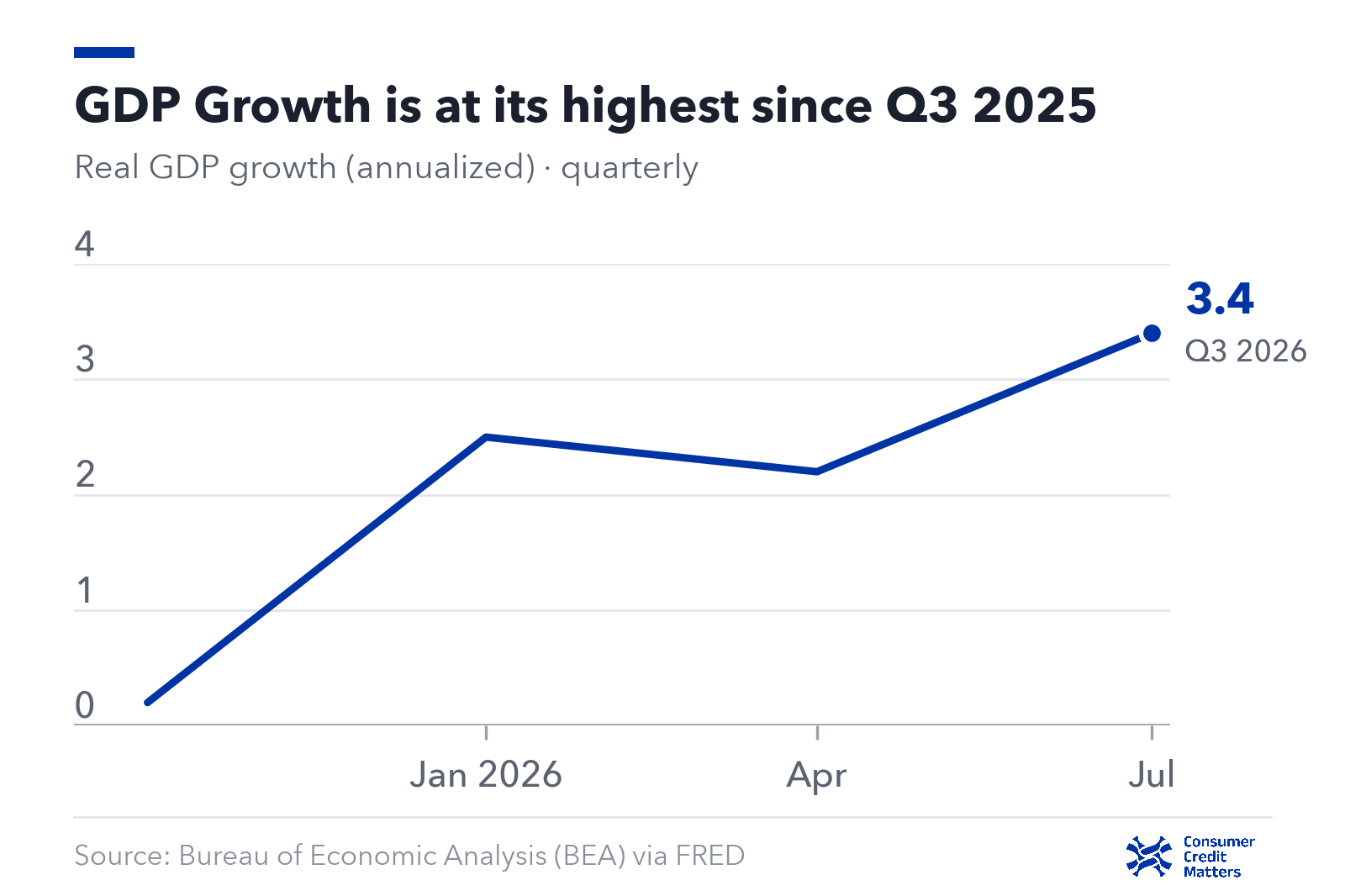
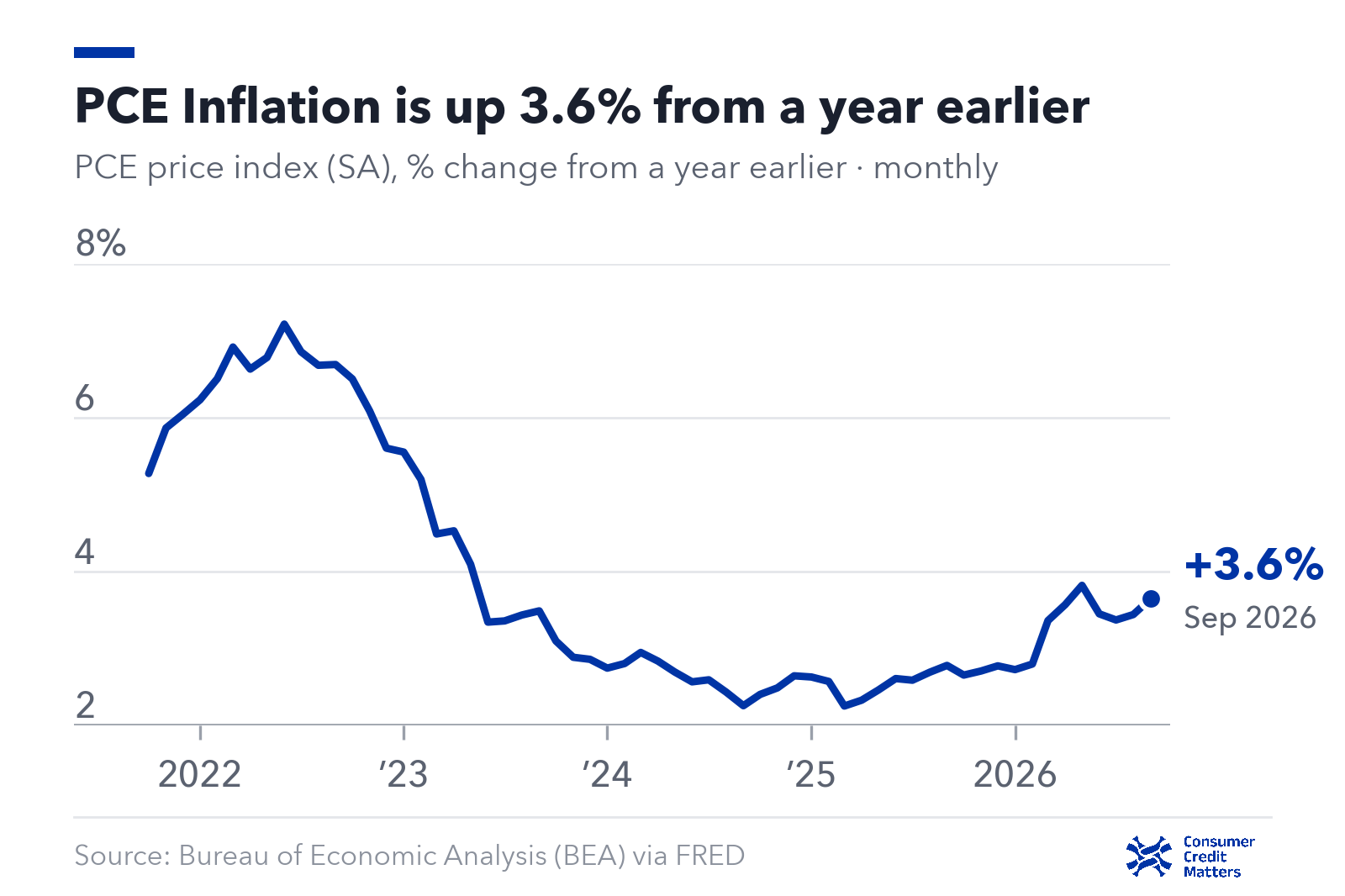
Q3 GDP grew at a 3.4% annualized pace, ahead of consensus, on the strength of consumer spending. The BEA’s September income report, released the same day, shows what is carrying it. Spending outran income in September, and with prices up 0.5% in the month, real disposable income fell 0.3% while real spending held flat. The personal saving rate slipped to 3.8%, the lowest since October 2022.
CCM read: A falling saving rate can signal confidence, and for wealthier households buoyed by asset prices, it may. But September’s drop came with flat real spending and falling real income, which looks more like a price squeeze than exuberance. For nonprime borrowers, with thinner buffers and little asset cushion, that is credit-negative at the margin: the thinner the buffer, the faster a softening labor market tends to show up in delinquencies.
Source: NAHB Eye on Housing · Oct 29 ↗
New Deals & Presale Reports
2 publicly registered issues this weekEach deal opens its CCM presale report. SEC publicly registered transactions only — 144A and private placements excluded. Full library: CCM Issuance table.
| Issuer / Series | Asset class | PSR | Close | Size ($MM) | WAL (yrs) | WA FICO |
|---|---|---|---|---|---|---|
| Preliminary — final prospectus not yet filed | ||||||
| HART 2026-DHyundai Auto Receivables Trust 2026-DPrelim | Auto Loan | — | 1,500.0 | — | 775 | |
| HAROT 2026-4Honda Auto Receivables 2026-4 Owner TrustPrelim | Auto Loan | Nov 21 | 1,579.0 | — | 772 | |
Loan-Level Pulse
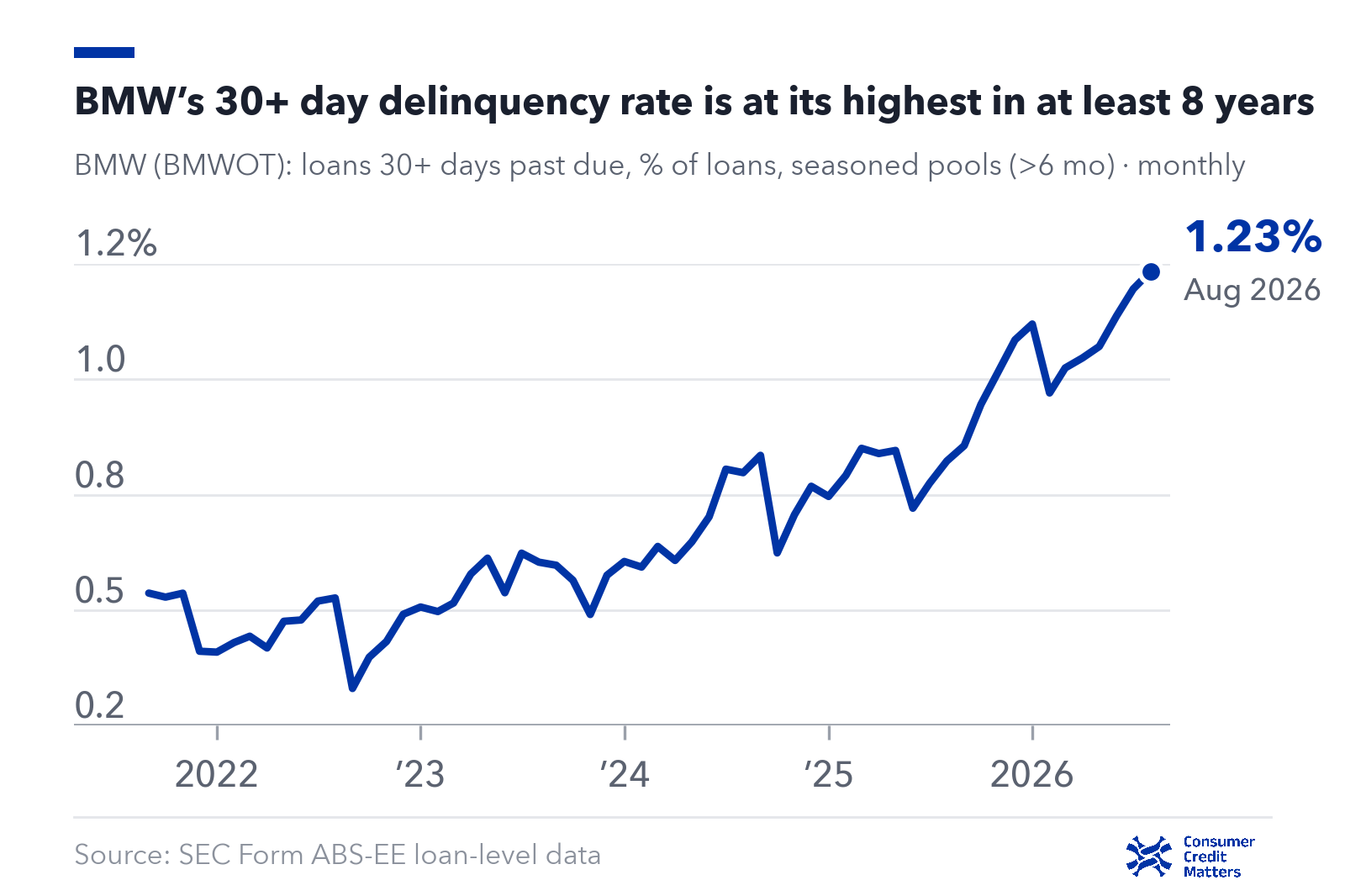
Reproducible signals · ABS-EE surveillanceA few signals from this week's loan-level tape — each links to the exact view on CCM so you can reproduce it. Explore the full data ›
BMW
Macro
Rates · Used cars · ConsumerPersonal Savings Rate
Real disposable income
GDP Growth
PCE Inflation
On Deck
Data releases · ABS-EE filings · eventsMacro releases
- Nov 02Auto Loan Demand (SLOOS)
- Nov 02Cons. Loan Lndg Stds (SLOOS)
- Nov 02Cons. Loan Demand (SLOOS)
- Nov 02CC Lndg Stds (SLOOS)
- Nov 02CC Demand (SLOOS)
- Nov 02Recession Probability
- Nov 02Auto Lndg Stds (SLOOS)
- Nov 03JOLTS Layoffs Rate
- Nov 03JOLTS Hires Rate
- Nov 03JOLTS Quits Rate
- Nov 03JOLTS Job Openings
- Nov 05Continued Claims
- Nov 05Labor Productivity
- Nov 0515-Year Mortgage Rate
- Nov 0530-Year Mortgage Rate
- Nov 05Initial Claims
- Nov 06Auto Loan ABS Issuance
- Nov 06Revolving Credit
- Nov 06Avg Hourly Earnings
- Nov 06Avg Weekly Hours
- Nov 06Nonfarm Payrolls
- Nov 06EPOP (SA)
- Nov 06Underemployment
- Nov 06Unemployment Rate
- Nov 06New Car Loan Rate (60-mo)
- Nov 06Financial Services Employment
- Nov 06Student Loan ABS Issuance
- Nov 06Credit Card Interest Rate
- Nov 06Prime-Age LFPR (25-54)
- Nov 06Construction Employment
- Nov 06Manufacturing Employment
- Nov 06Government Employment
- Nov 06Part-Time Workers
- Nov 06Long-Term Unemployed (27+ wk)
- Nov 06Sahm Rule
- Nov 06Non-Revolving Credit
- Nov 06Labor Force Participation
- Nov 06Average New Car Loan Size
- Nov 06Auto Loan Rate (48-mo)
- Nov 06Total Consumer Credit
- Nov 06Average New Car Loan Term
ABS-EE filings expected
- Nov 02BMW Vehicle Lease TrustBMWLT · ABS-EE 10-D · last filed Oct 02
- Nov 02BMW Vehicle TrustBMWOT · ABS-EE 10-D · last filed Oct 02
- Nov 16Bridgecrest Lending Auto Securitization TrustBLAST · ABS-EE 10-D · last filed Oct 15
- Nov 16CarMax Auto TrustCAOT · ABS-EE 10-D · last filed Oct 15
- Nov 16Carvana Auto Receivables TrustCRVNA · ABS-EE 10-D · last filed Oct 15
- Nov 16Drive Auto Receivables TrustDRIVE · ABS-EE 10-D · last filed Oct 15