Briefings
Gas is up 42% in a year. Is the squeeze showing up in consumer credit yet?
Anyone who has filled a tank since spring knows gas is expensive: regular averaged $4.49 a gallon on Sept. 25, up 42% from a year earlier. Few prices loom larger for consumers. San Francisco Fed research finds that when households expect gas prices to climb, they expect inflation overall to climb too, and the link is strongest among lower-income households. The question for credit is whether that pain is turning into missed payments.
Fuel works like a regressive tax: the bill scales with miles driven, not income. CCM's state fuel burden index (gallons used × price ÷ household income) shows how unevenly it lands. Mississippi and Alabama carry nearly twice the national burden despite some of the cheapest gas in the country. Even Indiana, with a state gas tax holiday, remains above average. See Exhibit 1.
Exhibit 1
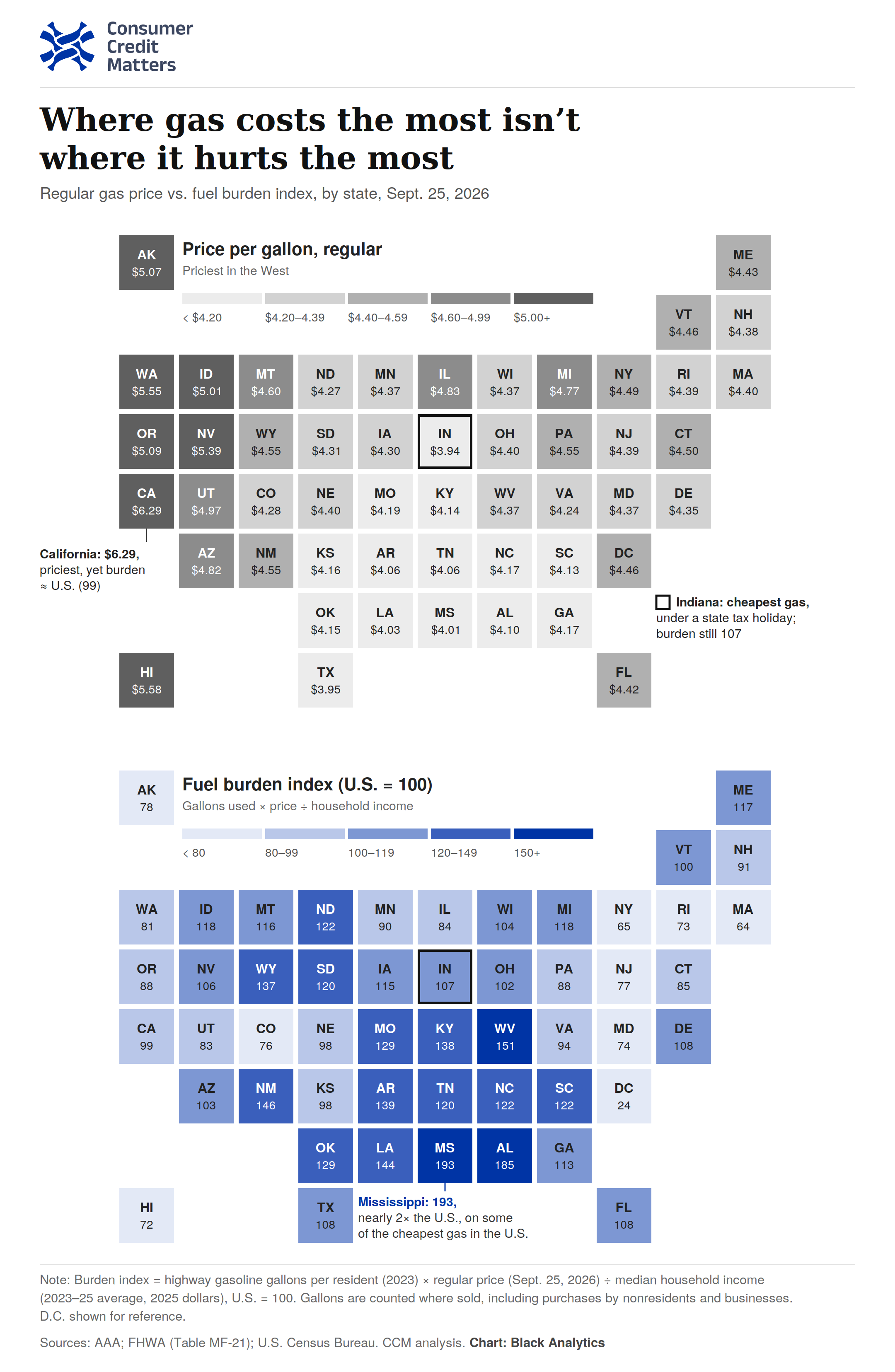
So far, auto loans show no sign of it. CCM tracked 7.1 million active auto loans in 23 public ABS programs. Since January, the share 60+ days past due has held essentially flat in both the ten highest-burden states[1] and the ten lowest; over the same months last year, it rose about 0.2 points. Even comparing the same lender's borrowers, high-burden states did no worse. Their delinquency rate is higher (2.78% vs. 1.83%), but it was higher before gas spiked, mostly because more of their loans come from subprime lenders.
CCM read: The pump-price squeeze is real, but it hasn't turned into missed car payments. That may say more about where we're looking than about household health. Borrowers protect the car they need to get to work: recent Philadelphia Fed research finds auto payments rank second only to housing, ahead of credit cards. If the strain shows up, cards and other unsecured credit are the likelier place to see it first.
- [1]High-burden states are the ten where fuel takes the largest share of income: MS, AL, WV, NM, LA, AR, KY, WY, OK and MO. Low-burden states are the ten smallest: WA, AK, NJ, CO, MD, RI, HI, NY, MA and DC. Rates are the share of active, scored loans 60+ days past due, as on the CCM explorer. From the January–February 2026 average to July, rates moved −0.01 points in high-burden states and +0.03 in low-burden states, versus +0.24 and +0.18 over the same months of 2025. Giving high-burden states the low-burden lender mix, with each lender's own rate held constant, lowers their July rate from 2.78% to 1.93%, vs. 1.83%." ↩
Sources: AAA state gas price averages (regular, as of Sept. 25, 2026) ↗ · FHWA Highway Statistics, Table MF-21 (2023 highway gasoline use by state) ↗ · U.S. Census Bureau median household income by state, CPS Table H-8 (2023–25 average) ↗ · U.S. Census Bureau state population estimates ↗
New Deals
7 publicly-registered issues pricedClick any row to open the CCM Issuance table. SEC publicly registered transactions only — 144A and private placements excluded.
| Issuer / Series | Asset class | PSR | Close | Size ($MM) | WAL | WA FICO |
|---|---|---|---|---|---|---|
| Ford Credit Auto Owner Trust 2026-CUpdated | Auto Loan | Sep 28 | 1,578.9 | 2.34 | 753 | |
| Nissan Auto Receivables 2026-B Owner TrustUpdated | Auto Loan | Sep 30 | 1,285.7 | 2.31 | 784 | |
| CarMax Select Receivables Trust 2026-CUpdated | Auto Loan | Sep 28 | 600.0 | 2.14 | 608 | |
| Exeter Select Automobile Receivables Trust 2026-2Updated | Auto Loan | Sep 28 | 473.1 | 2.18 | 671 | |
| Hyundai Auto Receivables Trust 2026-CClosed | Auto Loan | Sep 23 | 2,066.2 | 2.39 | 774 | |
| American Express Credit Account Master Trust Series 2026-1Closed | Credit Card | Sep 22 | 1,250.0 | — | 752 | |
| Volkswagen Auto Lease Trust 2026-BClosed | Auto Lease | Sep 22 | 991.8 | 2.00 | 775 |
Loan-Level Pulse
Reproducible signals · ABS-EE surveillanceA few signals from this week's loan-level tape — each links to the exact view on CCM so you can reproduce it. Explore the full data ›
Nissan
Macro
Rates · Used cars · ConsumerConsumer sentiment (UMich)
Credit-card charge-off rate
Credit-card 30+ DQ rate
Long-Term Unemployed (27+ wk)
From the Pod
This week's episodeAI in Collections: Compliance Audits, Consumer Preferences, and Risk
Watch this episode on YouTube.
Watch on YouTube ›On Deck
Data releases · ABS-EE filings · eventsMacro releases
- Sep 282s10s Spread
- Sep 28Baa Credit Spread
- Sep 28Fed Funds Rate
- Sep 28Recession Indicator
- Sep 29FHFA House Price Index
- Sep 29JOLTS Job Openings
- Sep 29JOLTS Quits Rate
- Sep 29JOLTS Hires Rate
- Sep 29JOLTS Layoffs Rate
- Sep 29Case-Shiller Home Price Index
- Sep 30Real Consumer Spending
- Sep 30WTI Crude Oil Price
- Sep 30PCE Inflation
- Sep 30Core PCE
- Sep 30Auto Dealer Inventories
- Sep 30Auto Sales (SAAR)
- Sep 30Real Disposable Income
- Sep 30Personal Savings Rate
- Sep 30GDP Growth
- Sep 30Real GDP (Level)
- Sep 30Auto Inventory/Sales Ratio
- Oct 0130-Year Mortgage Rate
- Oct 01Recession Probability
- Oct 01Continued Claims
- Oct 01Initial Claims
- Oct 0115-Year Mortgage Rate
- Oct 02Nonfarm Payrolls
- Oct 02EPOP (SA)
- Oct 02Underemployment
- Oct 02Unemployment Rate
- Oct 02Financial Services Employment
- Oct 02Labor Force Participation
- Oct 02Part-Time for Economic Reasons
- Oct 02Construction Employment
- Oct 02Manufacturing Employment
- Oct 02Government Employment
- Oct 02Long-Term Unemployed (27+ wk)
- Oct 02Sahm Rule
- Oct 02Avg Weekly Hours
- Oct 02Prime-Age LFPR (25-54)
- Oct 02Avg Hourly Earnings
ABS-EE filings expected
- Sep 26Toyota Auto Receivables TrustTAOT · ABS-EE 10-D · last filed Aug 27
- Sep 26Fifth Third Auto TrustFTAT · ABS-EE 10-D · last filed Aug 27
- Sep 27World Omni Select Auto TrustWOSAT · ABS-EE 10-D · last filed Aug 28
- Sep 27World Omni Automobile Lease Securitization TrustWOALT · ABS-EE 10-D · last filed Aug 28
- Sep 27World Omni Auto Receivables TrustWOART · ABS-EE 10-D · last filed Aug 28
- Sep 30Exeter Automobile Receivables TrustEART · ABS-EE 10-D · last filed Aug 31