Briefings
Card losses fell again in Q3, and the lenders got more careful
The nine card lenders behind the trusts CCM tracks reported third-quarter results between October 13 and 23. Three things stand out.
Losses fell at eight of nine issuers; delinquency was flat or lower at all nine. The exception is Barclays, whose U.S. card loss rate rose on a book shrunk by the April sale of its roughly $8 billion American Airlines portfolio to Citi (Exhibit 1).
Three issuers lowered their full-year loss forecasts. Citi now expects about 4% on U.S. cards, the bottom of its range; Bread cut to below 7% for the second time this year; Synchrony to below 5.5%.
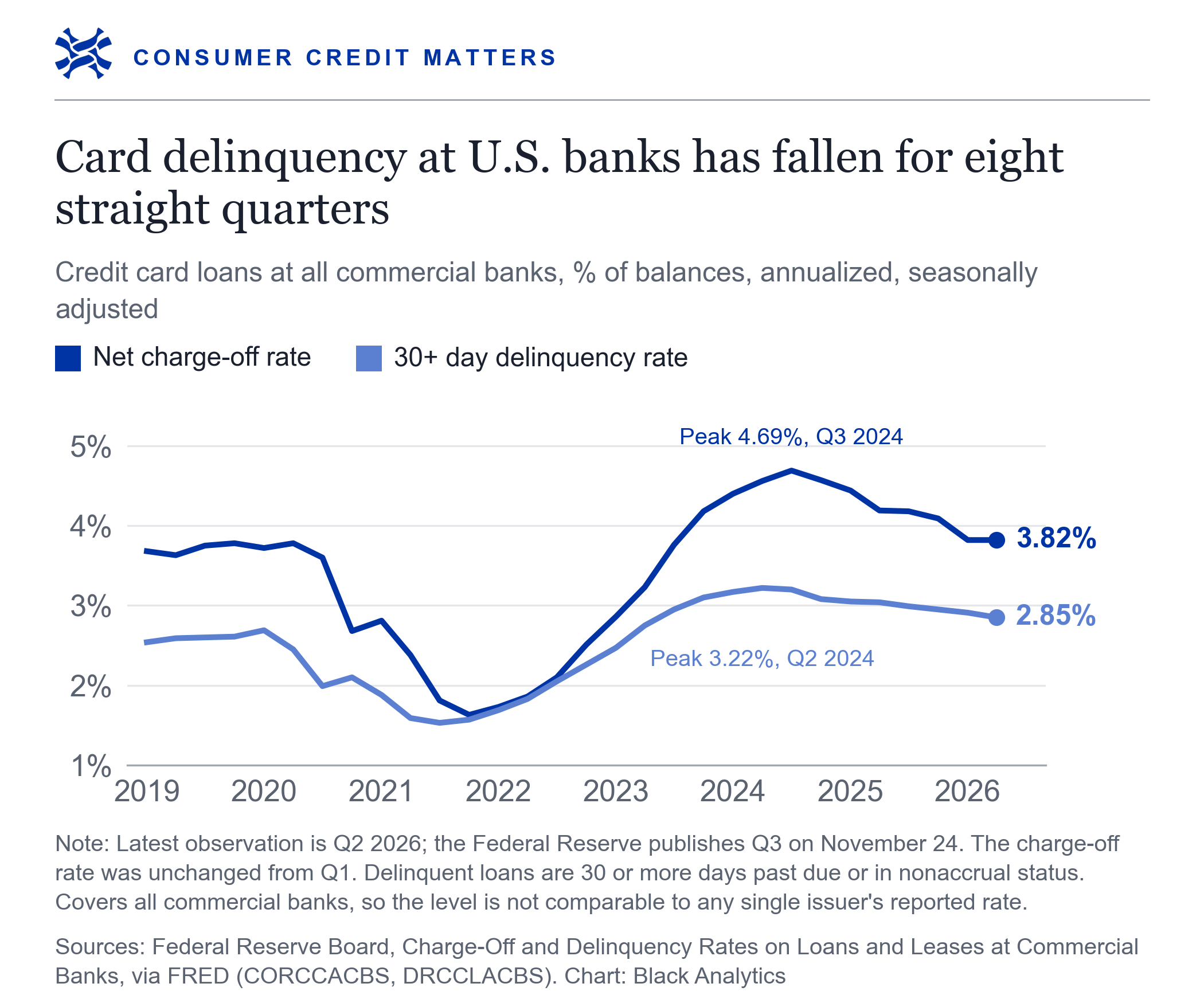
The Fed’s all-bank aggregate, a quarter behind, says the same. Card delinquency at commercial banks has fallen for eight straight quarters. The charge-off rate was 3.82% in June, down from 4.19% a year earlier but flat on the quarter, the first quarter without a decline since the 2024 peak (Exhibit 2).
Exhibit 1
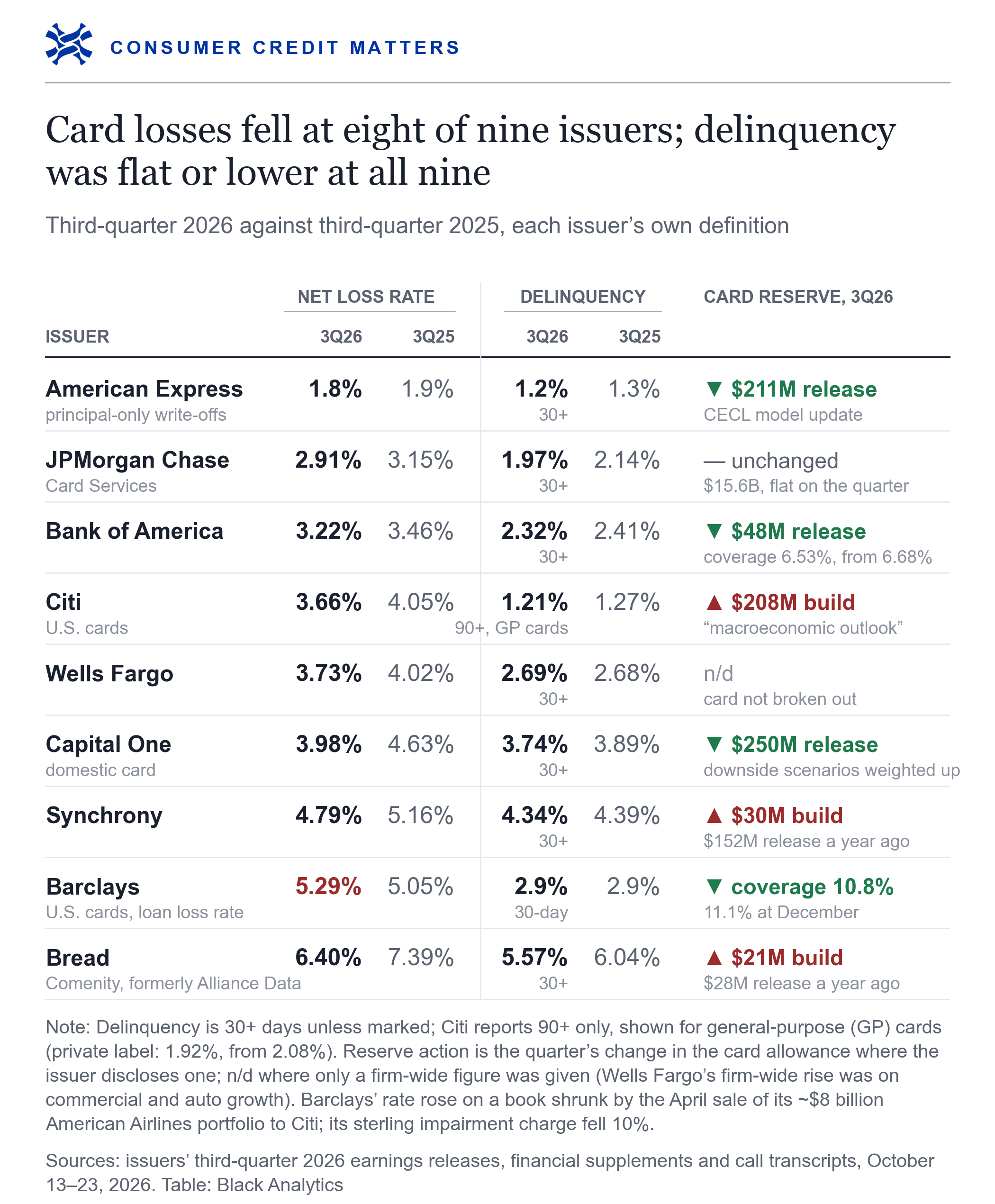
Reserves have stopped tracking losses. Synchrony and Bread, which both released reserves in the third quarter of last year, built them this quarter. Citi, which released $232 million against U.S. cards last quarter, added $208 million this quarter, citing the macroeconomic outlook. Capital One and American Express both released. Capital One cut its domestic card allowance by $250 million while giving “greater consideration to downside economic scenarios”; American Express released $235 million against card balances, citing lower delinquencies.
The forward language has turned careful. Capital One says its delinquencies are now “moving with seasonality... as opposed to beating it.” Bread, whose delinquencies are still beating the season, expects next year’s improvement to be smaller than this year’s.
And the condition attached to every forward comment is employment. JPMorgan’s CFO put it plainly: the consumer is “very healthy, primarily because of a healthy labor market,” and an extended rate cycle “almost by definition” means higher unemployment and “weaker consumer credit results.” Wells Fargo said its underwriting “recognize[s] that at some point, consumer credit conditions will weaken,” then added: “we do not see signs of this yet.”
Exhibit 2
CCM read: The numbers are better nearly everywhere, and the lenders reporting them are being cautious about what comes next. What follows is a question about employment, not about cards. Charge-offs follow delinquencies by roughly two quarters, so the prints already in the pipeline look good into early next year. After that, watch the reserve line, not the loss line.
Private lenders took over graduate student loans this fall. Where the loans go next is the open question.
When Grad PLUS closed to new borrowers on July 1, CCM wrote that the ABS supply would arrive with the loans, not the legislation. Sallie Mae’s third quarter, the first peak season under the new rules, is the first hard read. Four things stand out.
The demand showed up. Sallie Mae originated $3.4 billion of private education loans in the quarter, up 15% and the most in any quarter in its history. Graduate originations rose 119%, to about $1.4 billion, and October disbursements were running 35% above last year as of the October 22 call.
Credit held at Sallie Mae; one smaller lender is reaching further. The average winning FICO at approval, the higher of borrower’s and cosigner’s, was 757, 92% of loans were cosigned, and the graduate loans averaged nine points above the company’s other new originations. South Carolina Student Loan told the Wall Street Journal it has cut its minimum score to 600 from 670 for healthcare students and that its graduate volume is up 300 to 400 percent.
Where the loans go next is not settled. Sallie Mae cancelled a planned whole-loan sale because the premium on offer was below its threshold; management attributed its earnings cut, to $1.95 to $2.05 a share from $3.10 to $3.20, primarily to that decision, and expects “meaningful loan sales” to return in 2027. It also signed Sixth Street to buy at least $1.5 billion of loans a year for three years, the first year including a $600 million seasoned seed portfolio, on the model of its KKR agreement, and said its “next priority” is building the same flow capacity for graduate loans.
The credit noise was real but specific. Net charge-offs were $90 million against $77.5 million a year ago, full-year guidance rose to $400 to $420 million from $365 to $385 million, and 30+ delinquency was 4.2% of loans in repayment, from 4.0%. Management attributed the charge-off pressure to “misaligned third-party debt resolution practices” affecting a relatively small number of borrowers.
CCM read: The private loans filling the space federal graduate lending left are underwritten in full; Grad PLUS screened only for adverse credit history. In the first academic year under the new rules, lenders have gone in different directions. Sallie Mae’s new graduate borrowers score above its other new loans, while South Carolina Student Loan has lowered its minimum score to meet demand. Watch where the loans get funded, too. Forward-flow agreements with private credit do not by themselves keep collateral out of the term market, but they change who owns the loans and when, and Sallie Mae is now building that channel for graduate loans specifically. Navient reports on November 4; the 2027 calendar will give the first read on how much of the new graduate lending reaches ABS at all.
New Deals & Presale Reports
3 publicly registered issues this weekEach deal opens its CCM presale report. SEC publicly registered transactions only — 144A and private placements excluded. Full library: CCM Issuance table.
| Issuer / Series | Asset class | PSR | Close | Size ($MM) | WAL (yrs) | WA FICO |
|---|---|---|---|---|---|---|
| Closed this week | ||||||
| MBALT 2026-BMercedes-Benz Auto Lease Trust 2026-B | Auto Lease | Oct 22 | 1,322.4 | 1.84 | 788 | |
| BLAST 2026-4Bridgecrest Lending Auto Securitization Trust 2026-4 | Auto Loan | Oct 22 | 750.0 | 1.32 | 575 | |
| CAOT 2026-4CarMax Auto Owner Trust 2026-4 | Auto Loan | Oct 21 | 1,350.0 | 2.79 | 765 | |
Loan-Level Pulse
Reproducible signals · ABS-EE surveillanceA few signals from this week's loan-level tape — each links to the exact view on CCM so you can reproduce it. Explore the full data ›
Volkswagen
Macro
Rates · Used cars · ConsumerConsumer sentiment (UMich)
Credit-card charge-off rate
Student Loan ABS Issuance
Revolving consumer credit
On Deck
Data releases · ABS-EE filings · eventsMacro releases
- Oct 26CFNAI
- Oct 27Median New Home Price
- Oct 27New Home Months Supply
- Oct 27Building Permits
- Oct 27FHFA House Price Index
- Oct 27Case-Shiller Home Price Index
- Oct 29Real GDP (Level)
- Oct 2930-Year Mortgage Rate
- Oct 29Auto Inventory/Sales Ratio
- Oct 29Auto Dealer Inventories
- Oct 29Initial Claims
- Oct 29GDP Growth
- Oct 29Core PCE
- Oct 29Personal Savings Rate
- Oct 29Real Consumer Spending
- Oct 29Real Disposable Income
- Oct 29PCE Inflation
- Oct 29Continued Claims
- Oct 2915-Year Mortgage Rate
- Oct 29Auto Sales (SAAR)
ABS-EE filings expected
- Oct 26Porsche Innovative Lease TrustPILOT · ABS-EE 10-D · last filed Sep 24
- Oct 28Fifth Third Auto TrustFTAT · ABS-EE 10-D · last filed Sep 28
- Oct 29World Omni Auto Receivables TrustWOART · ABS-EE 10-D · last filed Sep 29
- Oct 29World Omni Select Auto TrustWOSAT · ABS-EE 10-D · last filed Sep 29
- Oct 29World Omni Automobile Lease Securitization TrustWOALT · ABS-EE 10-D · last filed Sep 29
- Oct 29Exeter Automobile Receivables TrustEART · ABS-EE 10-D · last filed Sep 29