Briefings
Who keeps the early defaults? The buyback clause that sets Santander's auto ABS apart
Subprime auto ABS are judged, deal by deal, on the losses in their monthly servicer reports. For the largest issuer, about half of SEC-registered subprime auto ABS outstanding in 2024-25, those numbers leave something out. Santander's trusts default early no more often than Exeter's, but under a clause CCM found in no other public program, Santander buys a third to half of those loans back at par. Its deals' first-year losses would be a quarter to a third higher if they were counted. Bondholders are protected by it; anyone comparing underlying loan performance has to account for it. And as Santander folds its consumer lender into its bank, the promise has moved with it, though the loans behind it are leaving public view.
CCM looked at every buyback reported by 475 SEC-registered auto loan trusts in 22 programs from January 2017 to September 2026: $2.5 billion in all.[1] Twelve of the 22 programs buy back less than 0.01% of their balance a year. Santander's two subprime programs, Santander Drive (SDART) and Drive Auto Receivables (DRIVE), buy back 0.84% and 1.68%: together 76% of all buyback dollars, on 18% of the pool balance (Exhibit 1).
Exhibit 1
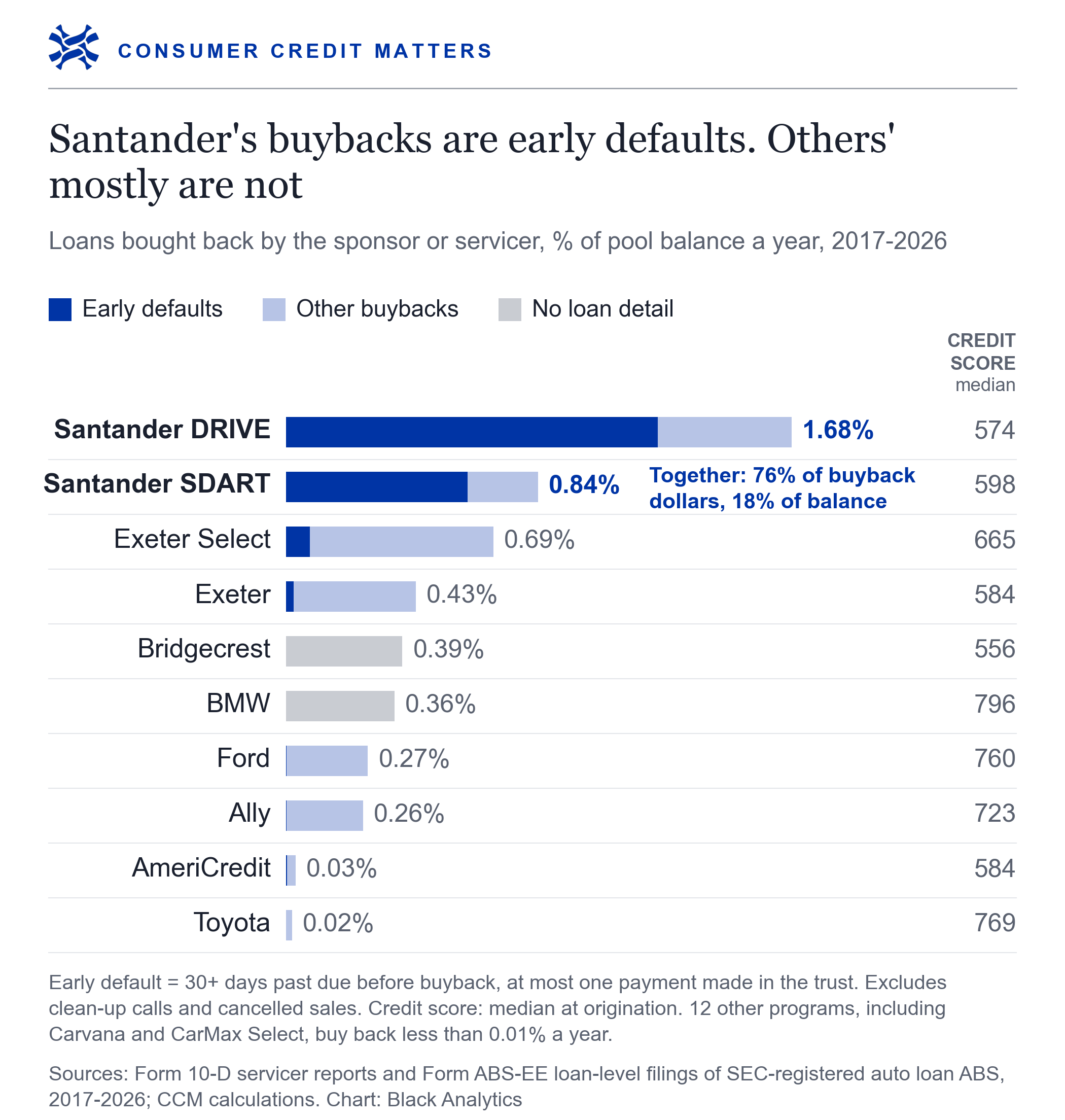
What gets bought back. Elsewhere a buyback is mostly an administrative matter: a current loan the servicer modified beyond what the deal allows, which most deals require it to purchase. At Santander nearly three-quarters of the dollars are early defaults, loans 30 or more days past due that had made at most one payment in the trust. Credit alone doesn't explain the gap. AmeriCredit, GM Financial's subprime program, has the same median credit score as Exeter and buys back 0.03% a year.
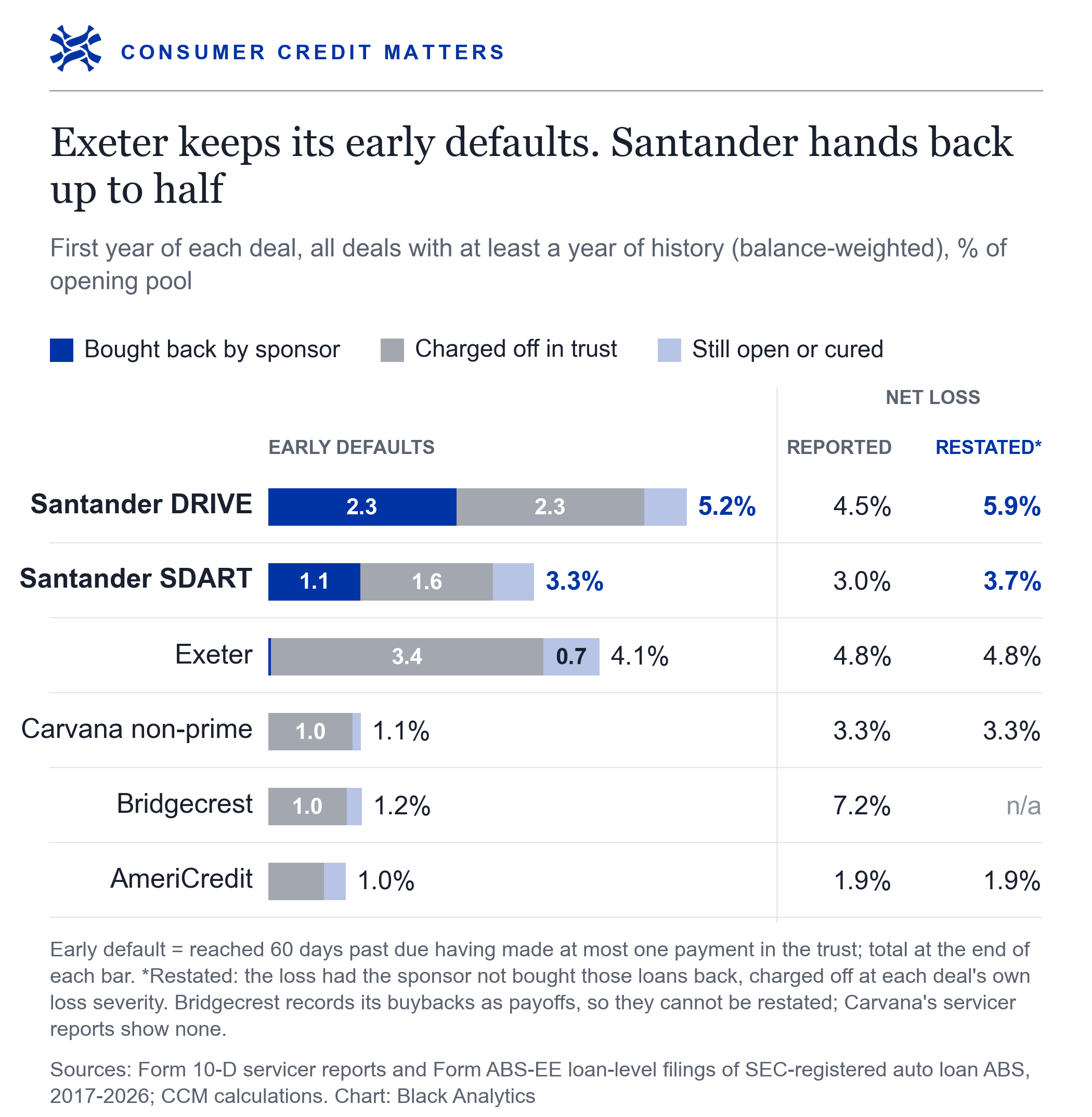
Who keeps the early defaults. Santander's pools don't default early more often than its peers'. Across all deals with at least a year of history, 3.3% of SDART's opening pool and 4.1% of Exeter's reached 60 days past due in the first year having made at most one payment. Exeter charges almost all of them off in the trust. Santander buys back about a third of SDART's and close to half of DRIVE's (Exhibit 2).[2]
Exhibit 2
Smaller than it was. Santander's buybacks peaked early: its two programs bought back $448 million in 2018, 3.7% of their balance, and since 2020 the rate has run at 0.4% to 0.9% a year. Better borrowers explain little of it. Among loans sold within two months of origination, the share defaulting early in SDART's 2022-25 deals (2.9% to 4.0%) is no lower than in its 2017-19 deals; DRIVE's has eased, from about 6% to about 4% to 5%. Most of the drop came from the end of a second stream of modified, current loans in late 2019, and from pools sold more seasoned, past the first two payments the clause covers. The pandemic briefly emptied the pipeline. In April 2020 alone, more than one in six of the loans in Santander's trusts were granted a payment extension, and a third by June.[3] Buybacks fell by about 90% that spring and summer, consistent with payments deferred rather than missed, before recovering in 2021.
Exhibit 3
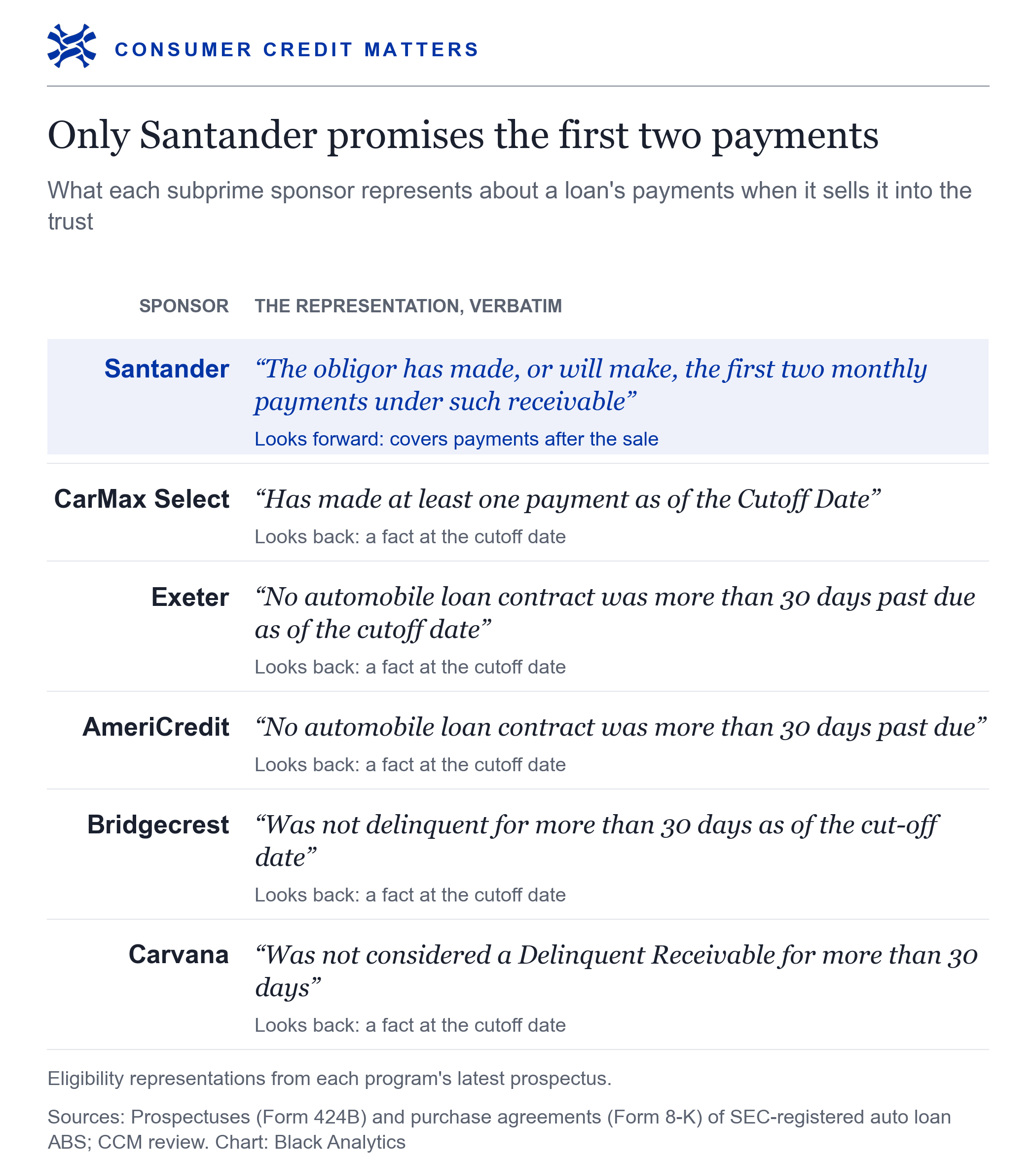
One clause. Every sponsor makes representations about a loan's payments when it sells it into a trust. All but one describe the loan as it stood at the cutoff date: not more than 30 days past due, or, at CarMax, that the borrower "has made at least one payment". Santander represents that the borrower "has made, or will make, the first two monthly payments" (Exhibit 3). If the borrower misses either payment, the representation is breached, and Santander must cure the breach or repurchase the loan at its balance plus interest. On EDGAR the wording appears in 351 filings, all Santander's, starting in May 2017.[4]
The clause arrived two months after Santander settled with the Massachusetts and Delaware attorneys general, who had alleged that it funded loans from dealers that inflated borrowers' incomes; it did not admit wrongdoing.[5] Early payment default is the classic sign of a misrepresented application, and the clause moved that risk from bondholders to Santander.
Does it make a difference? For bondholders, yes, in their favor: the buyback is at par, so the trust bears none of those losses. For anyone reading the deals' loss numbers, it matters too. Count the early-default buybacks as charge-offs, net of recoveries at each deal's own loss severity, and SDART's first-year cumulative net loss, across all its deals, rises from 3.0% to 3.7%, and DRIVE's from 4.5% to 5.9%, a quarter to a third higher; other programs barely move (Exhibit 2). The filings disclose the repurchases, but not their effect on reported losses. The SEC's loan-level field for the reason a loan was repurchased, which even has a code for early payment default, is blank at every issuer. And the repurchase-disclosure rule counts repurchase demands, not repurchases a sponsor makes on its own, so Santander reported "no activity" for 2024, a year in which it bought back $155 million.[6]
Only as good as the promisor. The promise is the sponsor's own; a smaller lender's would be worth less. Santander's now carries a bank's credit. SDART 2026-1, in February, is its only SEC-registered deal this year. Its latest, the $1.3 billion SDART 2026-A in October, came from Santander Bank, N.A. (rated Baa1/A-/A by Moody's/S&P/Fitch) as a private placement, and according to Fitch the bank itself makes the same representation, word for word: the borrower "has made, or will make, the first two monthly payments."[7] What changes is visibility. A private deal files no loan-level data, so the early defaults this article measures will no longer be visible for Santander's newest pools.
CCM read: Santander's reported losses understate how its loans perform. That isn't concealment: the repurchases are disclosed, the clause protects bondholders, and the loss falls on Santander rather than the trust. But set SDART or DRIVE against Exeter or AmeriCredit on reported net loss, and Santander's first year looks up to a third better than its loans performed.
- [1]Amounts from each trust's monthly servicer report (Form 10-D); loan detail from the loan-level files (Form ABS-EE), used only where the two agree. Buyback rate: annual repurchases as a share of average pool balance, balance-weighted. Clean-up calls and Carvana's and Bridgecrest's cancelled sales are excluded. "About half": SDART and DRIVE were 49% to 52% of SEC-registered subprime auto balances in 2024-25. ↩
- [2]Balance-weighted. The clause covers the first two payments of a loan's life, so it reaches mainly loans sold within about two months of origination: Santander bought back about half of those early defaults and almost none on older loans. Counting loans bought back before they reached 60 days past due adds 0.05 points to SDART's rate and 0.1 to DRIVE's. ↩
- [3]Loan-level files: 17.6% of SDART and DRIVE loans were granted an extension in April 2020, and a third between March and June. Santander's 10-Q for the second quarter of 2020: "approximately one third" of its customers had received a COVID-19 deferral by June 30. ↩
- [4]SDART 2018-3 purchase agreement (Form 8-K, EX-10.1), representation (m), and every Santander prospectus since 2021. Earlier deals covered only defaults before the first payment (Asset Securitization Report, 16 June 2017). ↩
- [5]Bloomberg reported in 2019 that the clause followed the March 2017 settlement; CCM could not obtain the settlement text to confirm. ↩
- [6]Santander Consumer USA, Form ABS-15G for 2024. The seven other auto sponsors CCM checked filed the same; Rule 15Ga-1 covers demands to repurchase for breaches of representations, not repurchases a sponsor makes on its own. ↩
- [7]Fitch Ratings, "Santander Drive Auto Receivables Trust 2026-A: Representations & Warranties," 7 October 2026. Private placement and sponsor: Asset Securitization Report, 9 October 2026. Bank ratings: Santander Holdings USA, Form 10-Q for the second quarter of 2026; Fitch raised the bank from A- in May 2026. ↩
Used-car prices have turned up — at the dealer, not the auction
Used-vehicle prices in the CPI rose 0.7% in September, after 0.4% gains in July and August: three straight monthly increases. They are still 1.5% below a year ago. New-vehicle prices rose 0.6% over the year, against headline inflation of 3.7%.
The wholesale market points the other way. The Manheim Used Vehicle Value Index fell 1.1% in September and stood 0.6% below a year earlier, its first full-month annual decline this year. Cox Automotive cut its forecast for the index's 2026 gain to 0.2%, from 2%, citing fuel costs and rising rates. Retail prices have tended to follow wholesale, so three months of CPI gains may not last.
For auto ABS, the auction is the price that counts. Repossessed cars are sold there, and returned lease cars are valued against it. Softer wholesale prices mean lower recoveries on defaulted loans and smaller gains on lease residuals.
Running a car is also costing more. Gasoline is up 34.2% from a year ago, 9.1% in September alone, and maintenance and repair 5.8%, while insurance is down 5.0%. For a stretched borrower, those bills compete with the car payment.
Exhibit 1
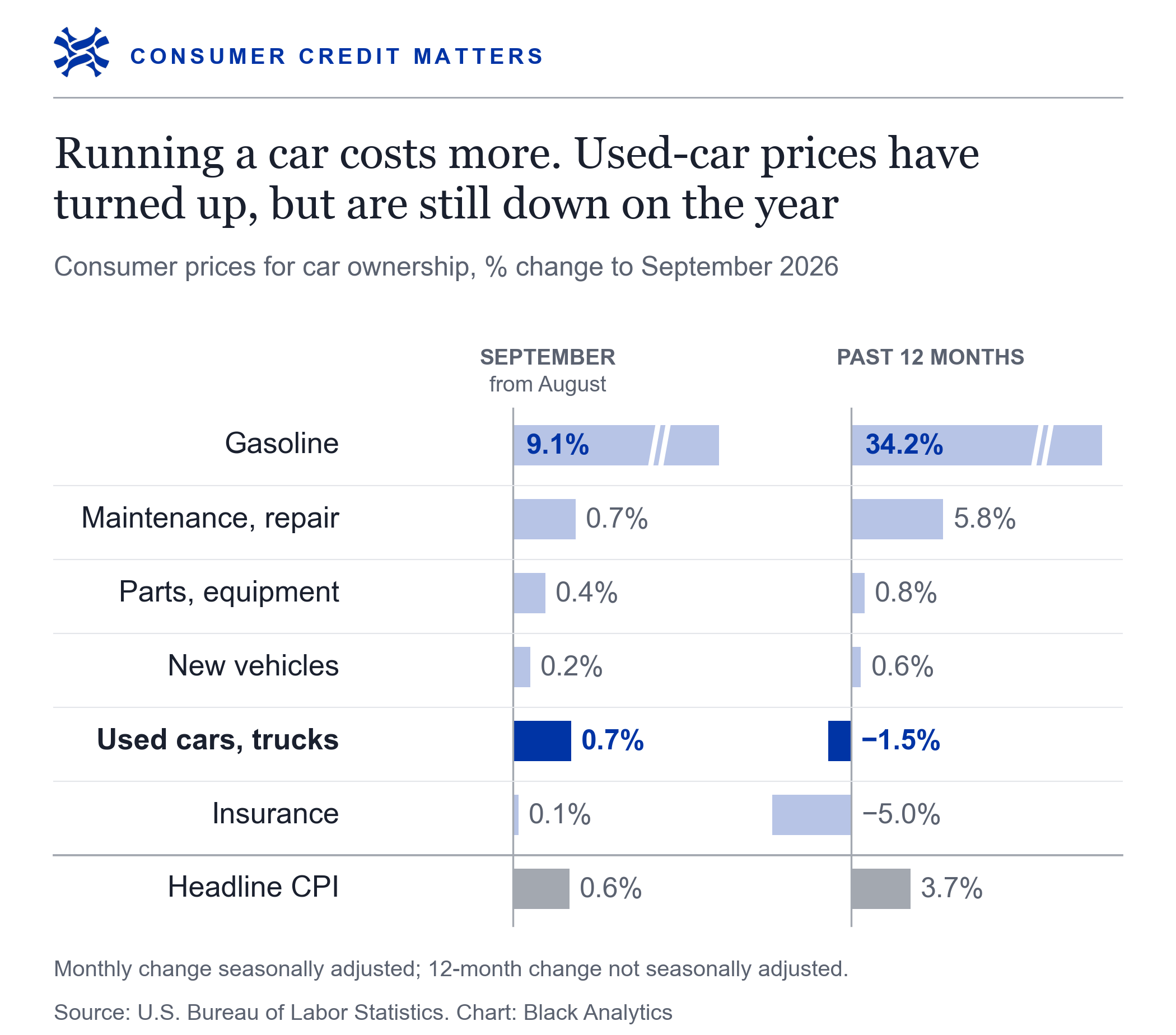
CCM read: The CPI measures what buyers pay at the dealership. For auto ABS, what matters is what cars fetch at auction, and auction prices are falling as fuel costs and interest rates rise. If that continues, recoveries on defaulted loans and gains on returned leases will feel it before the CPI shows it.
New Deals & Presale Reports
8 publicly registered issues this weekEach deal opens its CCM presale report. SEC publicly registered transactions only — 144A and private placements excluded. Full library: CCM Issuance table.
| Issuer / Series | Asset class | PSR | Close | Size ($MM) | WAL (yrs) | WA FICO |
|---|---|---|---|---|---|---|
| Preliminary — final prospectus not yet filed | ||||||
| MBALT 2026-BMercedes-Benz Auto Lease Trust 2026-BPrelim | Auto Lease | Oct 15 | 1,322.4 | 1.84 | 788 | |
| Priced this week | ||||||
| CAOT 2026-4CarMax Auto Owner Trust 2026-4 | Auto Loan | Oct 21 | 1,350.0 | 2.79 | 765 | |
| BLAST 2026-4Bridgecrest Lending Auto Securitization Trust 2026-4 | Auto Loan | Oct 22 | 750.0 | 1.32 | 575 | |
| Closed this week | ||||||
| FCFP 2026-3Ford Credit Floorplan Master Owner Trust A, Series 2026-3 | Floorplan | Oct 15 | 690.8 | — | — | |
| FCFP 2026-4Ford Credit Floorplan Master Owner Trust A Series 2026-4 | Floorplan | Oct 15 | 460.5 | — | — | |
| TAOT 2026-DToyota Auto Receivables 2026-D Owner Trust | Auto Loan | Oct 15 | 1,900.0 | 2.48 | 772 | |
| BMWLT 2026-2BMW Vehicle Lease Trust 2026-2 | Auto Lease | Oct 14 | 1,250.0 | 2.07 | 792 | |
| GMCAR 2026-4GM Financial Consumer Automobile Receivables Trust 2026-4 | Auto Loan | Oct 14 | 1,015.8 | 2.44 | 773 | |
Loan-Level Pulse
Reproducible signals · ABS-EE surveillanceA few signals from this week's loan-level tape — each links to the exact view on CCM so you can reproduce it. Explore the full data ›
Nissan
Macro
Rates · Used cars · ConsumerUsed-vehicle CPI
CPI (Not Seasonally Adjusted)
Auto Parts CPI
Initial Claims
On Deck
Data releases · ABS-EE filings · eventsMacro releases
- Oct 20Building Permits
- Oct 2230-Year Mortgage Rate
- Oct 22Initial Claims
- Oct 22Continued Claims
- Oct 2215-Year Mortgage Rate
- Oct 23Michigan Consumer Sentiment
ABS-EE filings expected
- Oct 16Ford Credit Auto TrustFCAOT · ABS-EE 10-D · last filed Sep 16
- Oct 16Ford Credit Auto Lease TrustFCALT · ABS-EE 10-D · last filed Sep 16
- Oct 19Honda Auto Receivables TrustHAROT · ABS-EE 10-D · last filed Sep 18
- Oct 21Volkswagen Auto Lease TrustVWALT · ABS-EE 10-D · last filed Sep 21
- Oct 21Volkswagen Auto Loan Enhanced TrustVALET · ABS-EE 10-D · last filed Sep 21
- Oct 21Mercedes-Benz Auto Receivables TrustMBART · ABS-EE 10-D · last filed Sep 21