Briefings
162,000 jobs, and most of them are where nonprime borrowers work
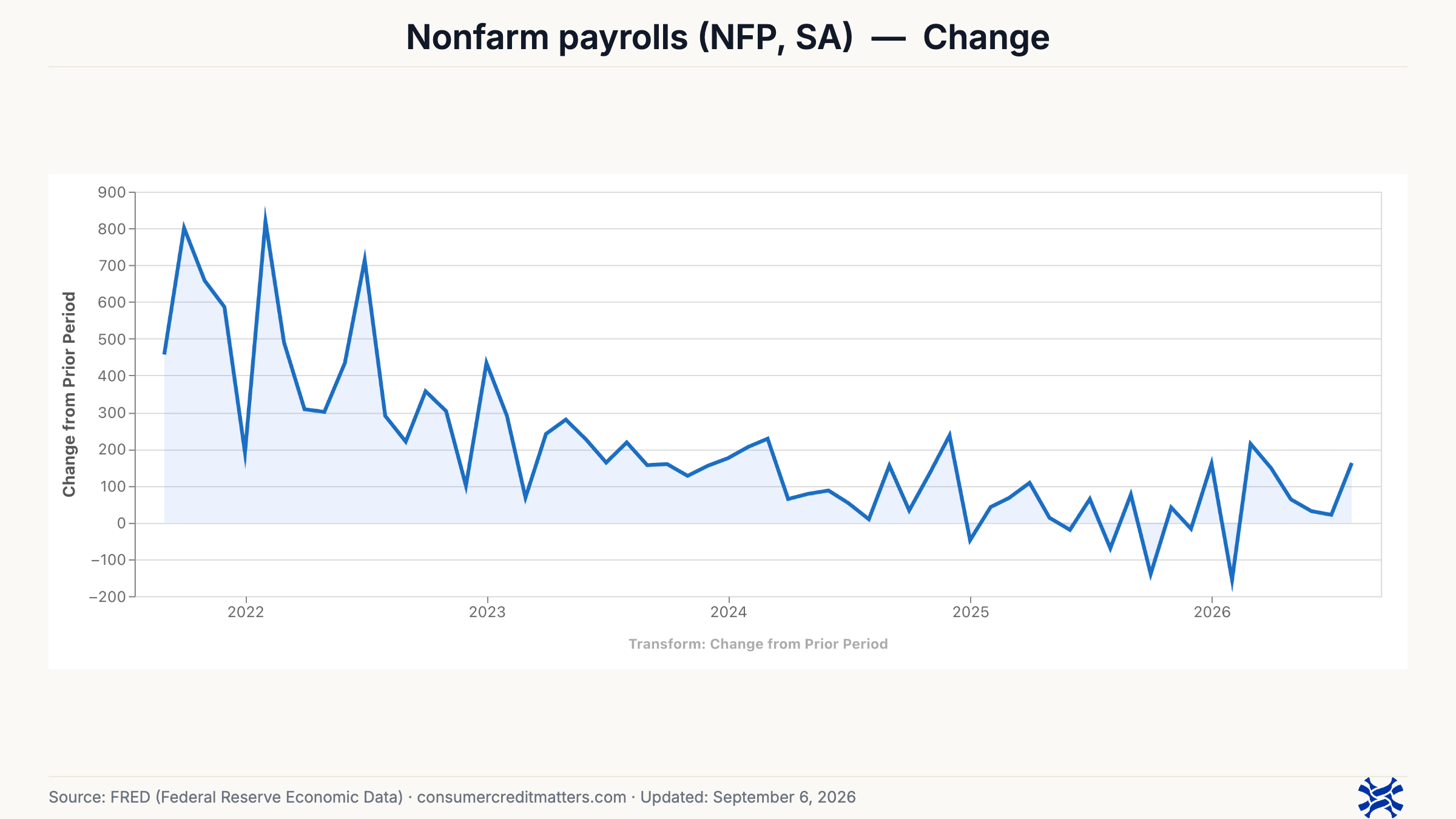
August payrolls rose 162,000 (Exhibit 1) against a consensus near 55,000, and June and July were revised up a combined 55,000. Unemployment held at 4.1%. The strength was broad, and the composition matters more for credit than the total.
Restaurants and bars added 59,000 jobs, manufacturing 16,000, and local government education 42,000, most of that reversing a July drop. Information lost 23,000, with a 12-month average of negative 8,000.
Read through a credit lens, hospitality is the lowest-paid major sector in the BLS data, and lower-income households tend to skew nonprime. So August's hiring lands disproportionately in the subprime auto and nonprime card borrower base. Employment, not real wages, is the first-order driver of nonprime performance, and this was the best month for that cohort in a year. Prime borrowers, meanwhile, are holding. The information losses are real but small against the prime base, and those households carry the buffers the K-shaped economy implies.
The caveat is purchasing power. Average hourly earnings rose 3.2% over the year through July while CPI rose 3.4%, so real earnings fell 0.2%, and energy and food weigh heaviest in nonprime budgets.
CCM read: The consensus story is a stressed subprime borrower. August says that borrower is employed, and employment is what pays the note. Expect nonprime roll rates to hold or improve in the October remits unless the September 11 CPI shows gas eating the gain. Prime is fine and the information trend is a watch item, not a call.
Exhibit 1
Hike odds rise to 59%, and three years of originations have never seen one
According to CME FedWatch, futures put a 59% probability on a 25bp hike at the September 15–16 meeting, up from 54% a month ago, with August CPI on the 11th the last word. The 2-year has climbed about 90bp this year to 4.37%, and the 10-year sits near 4.78%, its highest since January 2025.
The last hike was July 2023, and the last cut was December 2025, leaving the target range at 3.50–3.75%. A hike now would be the fastest turn from cutting to hiking since 1998–99, measured from the last cut, and every loan originated in the three years since has only ever seen rates fall. It is worth a refresher on where a hike lands.
Think of a hike as two events: one for the book you have, one for the book you are about to build. On the book you have, floating-rate collateral reprices and fixed does not, but the cash flows move in both cases. Cards and HELOCs reprice off prime within a billing cycle or two, so card trust yield rises before delinquencies do and, all else equal, excess spread widens, while payment rates drift lower as minimums rise. Existing auto, mortgage, and installment loans keep their terms, but borrower behavior does not hold still: prepayments slow as the refi and trade-in incentive disappears, pools extend, weighted average life lengthens, and excess spread accrues over a longer horizon.
On the book you are about to build, everything moves. Auto affordability worsens, terms lengthen, and negative equity deepens. New auto ABS funds seasoned lower-APR collateral at higher coupons, compressing excess spread, and subprime lenders on floating warehouse lines feel it before their deals price unless they are hedged. Fintech unsecured and BNPL credit boxes tighten. Mortgage lock-in deepens, and second-lien and HELOC securitization, already $24 billion through late July against $29 billion for all of 2025 according to Bank of America Securities, keeps growing as first-lien rates rise. Outside mortgages, the longest-dated fixed-rate collateral, solar loans especially, sees the largest price and spread moves because it carries the most duration.
CCM read: This is not 2023. That hike landed on top of 525bp on a book still normalizing out of stimulus. This one would land on a book the New York Fed says has held steady across most products for two years, with card delinquency transitions flat in Q2 and auto elevated and edging up. A single 25bp move is a margin event for issuers before it is a credit event for borrowers. What would change that is two or three more on top of a real-wage squeeze that is already four months old.
New Podcast: Episode 30 is out, and it is 40 years of consumer ABS from someone who was in the room
New Deals
2 publicly-registered issues pricedClick any row to open the CCM Issuance table. SEC publicly registered transactions only — 144A and private placements excluded.
| Issuer / Series | Asset class | PSR | Close | Size ($MM) | WAL | WA FICO |
|---|---|---|---|---|---|---|
| Capital One Prime Auto Receivables Trust 2026-1New | Auto Loan | — | 1,316.4 | — | 774 | |
| Exeter Automobile Receivables Trust 2026-4Closed | Auto Loan | Aug 31 | 1,031.0 | 1.37 | 585 |
Loan-Level Pulse
Reproducible signals · ABS-EE surveillanceA few signals from this week's loan-level tape — each links to the exact view on CCM so you can reproduce it. Explore the full data ›
Toyota
Macro
Rates · Used cars · ConsumerAvg Hourly Earnings
Avg Weekly Hours
Labor Productivity
Unemployment rate
From the Pod
This week's episode40 Years in ABS with John Costa: Monolines, Timeshare, Extendable ABCP & Bank Charters | Ep. 30
Watch this new episode on YouTube.
Watch on YouTube ›On Deck
Data releases · ABS-EE filings · eventsMacro releases
- Sep 07Recession Indicator
- Sep 08Auto Loan Rate (48-mo)
- Sep 082s10s Spread
- Sep 08Average New Car Loan Term
- Sep 08Baa Credit Spread
- Sep 08Average New Car Loan Size
- Sep 08New Car Loan Rate (60-mo)
- Sep 08Credit Card Interest Rate
- Sep 08Non-Revolving Credit
- Sep 08Total Consumer Credit
- Sep 08Fed Funds Rate
- Sep 08Auto Loan ABS Issuance
- Sep 08Student Loan ABS Issuance
- Sep 08Revolving Credit
- Sep 1015-Year Mortgage Rate
- Sep 10Continued Claims
- Sep 10WTI Crude Oil Price
- Sep 10Initial Claims
- Sep 1030-Year Mortgage Rate
- Sep 11Core CPI
- Sep 11Auto Parts CPI
- Sep 11Headline CPI
- Sep 11CPI (Not Seasonally Adjusted)
- Sep 11Auto Repair CPI
- Sep 11Used Car CPI
- Sep 11New Car CPI
ABS-EE filings expected
- Sep 13Carvana Auto Receivables TrustCRVNA · ABS-EE 10-D · last filed Aug 14
- Sep 16CarMax Auto TrustCAOT · ABS-EE 10-D · last filed Aug 17
- Sep 16Bridgecrest Lending Auto Securitization TrustBLAST · ABS-EE 10-D · last filed Aug 17
- Sep 16DRIVE AUTO RECEIVABLES TRUSTDRIVE · ABS-EE 10-D · last filed Aug 17
- Sep 16Santander Drive Auto Receivables TrustSDART · ABS-EE 10-D · last filed Aug 17
- Sep 16CarMax Select Receivables TrustCMXS · ABS-EE 10-D · last filed Aug 17